
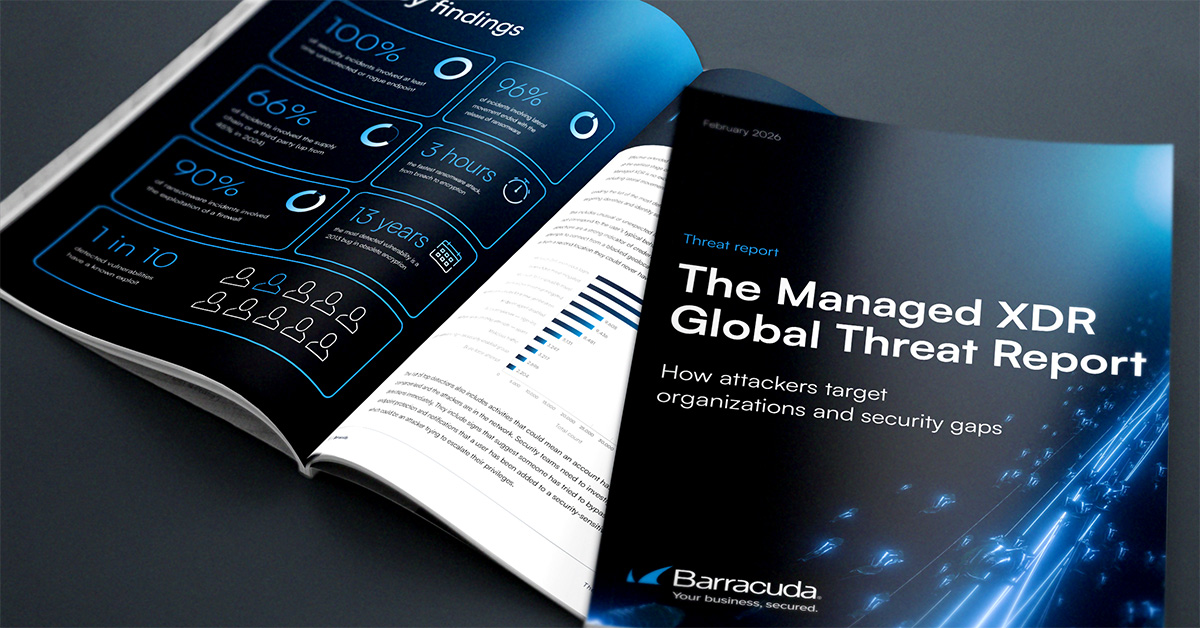
Lessons from around 600,000 security alerts analyzed by Barracuda Managed XDR
Takeaways
- In 2025, 90% of ransomware incidents exploited firewalls, and the fastest observed ransomware case took three hours from breach to encryption.
- The most widely detected CVE vulnerability dates from 2013, and 11% of detected vulnerabilities have a known exploit.
- Barracuda releases the Managed XDR Global Threat Report.
Cyberattacks are stealthy. They sneak into networks, looking for gaps, errors and oversights: a single rogue device, an account that wasn’t disabled when someone left, a dormant application that hasn’t been updated, or an accidentally disabled security feature. They’ll try to trick employees and steal their identities, take advantage of legitimate IT tools and join privileged access groups. Much of this will look like everyday IT activity.
For organizations and their security teams — especially if that ‘team’ is a single IT professional — this presents immense security challenges. With limited resources and visibility and a stack of fragmented security tools, they must safeguard identities, assets and data from attacks that can unfold in a matter of hours or lurk in the network for months.
How attackers target organizations and the security gaps that increase risk
The new Barracuda Managed XDR Global Threat Report highlights the tactics used by attackers over the last 12 months — and the security gaps exposing organizations to risk.
The threats are real, not theoretical. They are drawn from a unique, real-world dataset of more than two trillion IT events collected during 2025, around 600,000 security alerts and roughly 300,000 protected endpoints, firewalls, servers, cloud assets, and more. The data is complemented by incident summaries and practical steps on how to stay safe and cyber resilient.
The purpose of the report is to help IT and security professionals in resource-constrained organizations better understand how attackers target potential victims and the security weak spots they try to exploit.
Who’s really logging in, using that tool, joining that group?
The findings show how attackers exploit legitimate IT tools such as remote access software and leverage unprotected or rogue devices. They also highlight the risks of outdated encryption, disabled endpoint security, and more, and the warning bells of unusual login or privileged access behaviors.
Key findings
- 90% of ransomware incidents exploited firewalls through a CVE (a classified software vulnerability) or vulnerable account. Attackers can use this to gain access and control over the network and bypass its protection, hiding malicious traffic and activity.
- The fastest ransomware case observed involved Akira ransomware and took just three hours from breach to encryption. Such compressed timelines can leave defenders with minimal opportunity to detect and respond.
- One in 10 detected vulnerabilities had a known exploit. Attackers are actively weaponizing software bugs, often in the supply chain — and the importance of identifying and addressing unpatched software cannot be overstated.
- The most widely detected vulnerability dates to 2013. CVE-2013-2566 is a flaw in an outdated encryption algorithm that can be found in legacy systems such as old servers or embedded devices or applications.
- 96% of incidents involving lateral movement ended with the release of ransomware. Lateral movement is the moment attackers lurking on an unprotected endpoint break cover, and it represents the biggest red flag of an unfolding ransomware attack.
- 66% of incidents involved the supply chain or a third party (up from 45% in 2024) as attackers exploit weaknesses in third-party software to breach defenses and extend their reach.
Expect the unexpected
The report shows that there is no ‘one-size-fits-all’ when it comes to cyberattacks. Attackers are opportunistic and ‘kill chains’ are rarely, if ever, linear and neat.
Ransomware attacks are an excellent example. According to Barracuda Managed XDR’s detection and incident data, the fastest ransomware attacks in 2025 took just hours end-to-end, while the longest took months. Lengthy intrusions allow for maximum damage, and incidents that move at lightning speed can be harder to catch and contain before they’ve been executed.